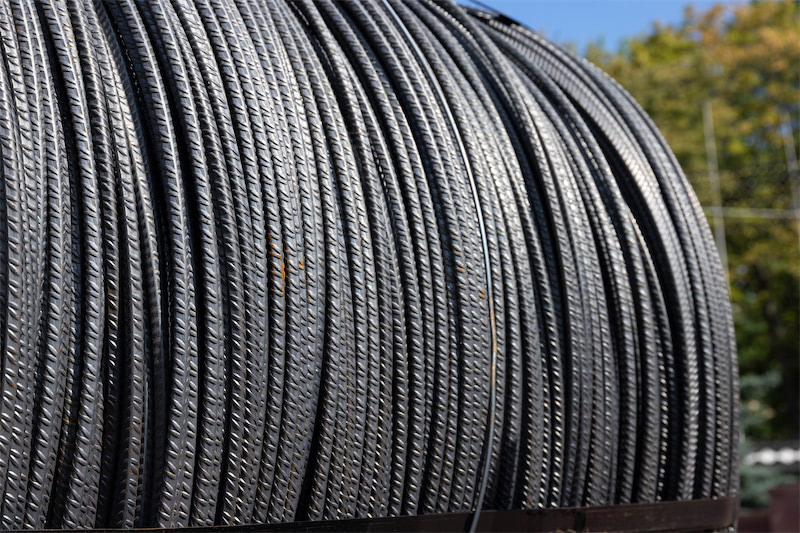
Stainless Steel Knowledge Popularization
1.What Is Stainless Steel?
To understand what stainless steel is, one must first understand what "steel" is. We can try to form a word with "steel," and I believe 99% of people would think of the same word—steel and iron. This shows the close relationship between steel and iron. Many people might think they are the same material, but in fact, there are significant differences between the two in various aspects.
The main difference between steel and iron lies in their chemical composition, especially the carbon content. From a definitional perspective, steel refers to a general term for iron-carbon alloys with a carbon content percentage between 0.02% and 2.11%. In contrast, iron typically has a carbon content of over 2%, with pig iron having an even higher carbon content, usually between 2% and 4.3%. Comparatively, steel has advantages in strength, hardness, wear resistance, and toughness.
Once we understand what steel is, stainless steel becomes easier to comprehend. In daily production and life, ordinary steel often fails to meet the growing material demands, necessitating a more corrosion-resistant raw material. Thus, stainless steel came into being. Stainless steel is an alloy steel with stainless and corrosion-resistant properties, primarily composed of elements such as iron, chromium, nickel, and manganese. According to the GB/T20878-2007 standard, stainless steel is defined as steel with a chromium content of at least 10.5% and a maximum carbon content of no more than 1.2%. The corrosion resistance of stainless steel depends on its alloying elements, particularly the chromium and nickel content. Chromium forms a chromium-rich oxide film (passivation film) to prevent further oxidation, while nickel enhances the steel's corrosion resistance and toughness.
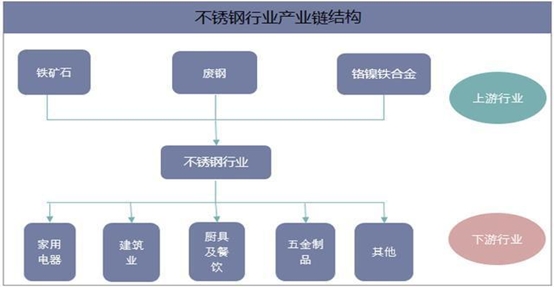
2.Stainless Steel Industry Chain
Stainless steel has a wide range of applications, from architectural structures to food processing equipment, medical instruments to daily necessities. Its corrosion resistance and aesthetic appeal make it the preferred material in many industries.
3.Classification of Stainless Steel
Based on the proportion of various elements in stainless steel, it is categorized into grades such as the 200-series (chromium-manganese), 300-series (chromium-nickel), and 400-series (chromium). Among these, the 300-series has excellent overall performance and a wide range of applications. The main representative steel grades are 201, 304, 430, and 410.
|
Steel Grade |
Main Applications |
|
201 |
Used for applications requiring high strength, non-magnetic properties, wear resistance, and low corrosion resistance. |
|
304 |
The most widely used, including household items (types 1 and 2 tableware, kitchen cabinets, indoor pipelines, water heaters, boilers, bathtubs), automotive parts (windshield wipers, mufflers, molded products), medical instruments, construction materials, chemical, food industries, agriculture, and ship components. |
|
430 |
Heat-resistant appliances, burners, home appliances, type 2 tableware, kitchen sinks, external decorative materials, bolts, nuts, CD rods, and screens. |
|
410 |
Blades, mechanical parts, petroleum refining equipment, bolts, nuts, pump rods, and type 1 tableware. |
|
Steel Grade |
Main Characteristics |
|
201 |
Lower nickel content, with added manganese, nitrogen, and copper; higher strength, lower corrosion resistance, and lower cost. |
|
304 |
Nickel content not less than 8%, with good corrosion resistance, heat resistance, excellent processing properties (stamping, bending, welding), no heat treatment hardening, and non-magnetic. |
|
430 |
May contain no nickel, magnetic, low thermal expansion rate, good processing properties, excellent oxidation resistance, general corrosion resistance, and low cost. |
|
410 |
May contain no nickel, lower corrosion resistance, and good wear resistance. |
4.Steel Rolling Process:
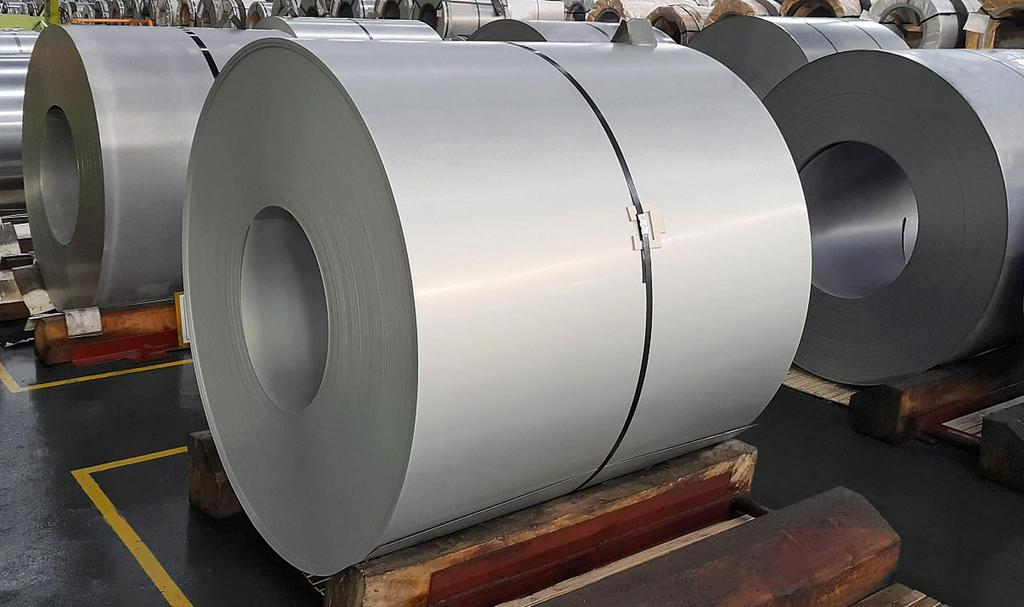
Hot Rolling (Steel Mill): Steel billets are heated and then passed through roughing and finishing mills. After cooling, they are coiled by a coiler. At this stage, the steel coil has a black oxide layer on the surface due to high-temperature heating, hence called "black stainless steel coil." If the coil undergoes annealing and pickling processes to remove the surface oxide layer, it becomes a "white stainless steel coil."
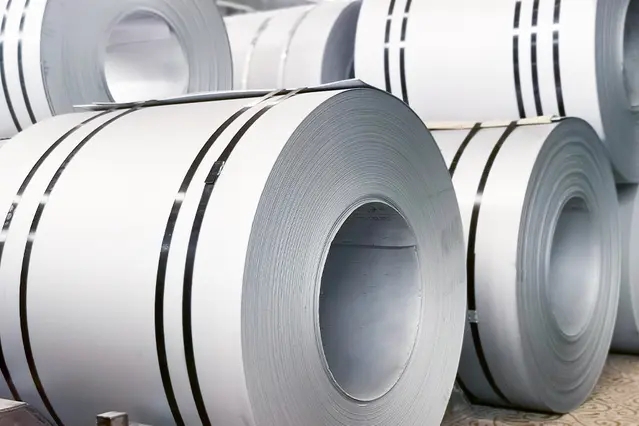
Cold Rolling (Steel Mill or Agents, Tolling Factories): Hot-rolled coils can already be sold as products with a thickness of 3-8mm. Some are further processed into cold-rolled products for use. Cold rolling generally uses hot-rolled products with a thickness of 3-5.5mm as raw materials. The main processes include single-stand cold rolling and multi-stand cold rolling. After passing through the rolling mill, the hot-rolled product undergoes continuous annealing and pickling, followed by leveling to form finished cold-rolled stainless steel coils, typically with a thickness of 1.2-2mm.
5.Composition of Stainless Steel
|
Steel Grade |
Nickel |
Chromium |
Manganese |
Carbon |
Silicon |
Phosphorus |
Nitrogen |
Sulfur |
|
201 |
3.5-5.5% |
16.0~18.0% |
5.5~7.50% |
≤0.15% |
≤1.00% |
≤0.050% |
≤0.25% |
≤0.030% |
|
304 |
8.0-10.5% |
18.0–20.0% |
≤2.00% |
≤0.08% |
≤1% |
≤0.045% |
≤0.030% |
|
|
430 |
≤0.60% |
16.00-18.00% |
≤1.00% |
≤0.12% |
≤0.75% |
≤0.040% |
≤0.030% |
Main Sources of Elements:
Nickel: Low-grade NPI (1.5%-1.7%), high-grade NPI (8%-12%)
Manganese: EMM, medium- and low-carbon ferromanganese, high-silicon SiMn alloy
Chromium: High-carbon ferrochrome
Iron: Plain carbon steel
(can be supplemented with recycled raw materials such as steel scrap or stainless steel scrap)
7. Frequently Asked Questions
1)Q: What Is the Difference Between 2B Coil and NO.1 Coil?
A: The main differences between 2B coil and NO.1 coil lie in their surface treatment, processing methods, applicable thickness ranges, and application fields. 2B coil has a smoother and shinier surface, with a thickness of less than 3mm, suitable for fine processing. NO.1 coil has a rougher surface, with a thickness of 3mm or more, suitable for industrial use or further processing as raw material.
2)Q: What Is the Difference Between Mill Edge and Slit Edge? A
: The main differences between mill edge and slit edge lie in their edge treatment, dimensional accuracy, appearance quality, and performance. Slit edge plates usually have higher dimensional accuracy and better appearance, while mill edge plates retain more original characteristics.
3) Q: What Is the Difference Between J1 and J2?
A: The difference between J1 and J2 mainly lies in their copper content. J1 has a copper content of 0.8%, making it softer and easier to process, with a relatively higher price. J2 has a copper content of 0.3%, with relatively higher hardness, more processing difficulty, and a lower price.
Image Sources:Search Results for Stainless Steel Hot-Rolled Coils on Baidu Image Search
Search Results for Stainless Steel Cold Rolling on Baidu Image Search
》Click to View SMM Stainless Steel Spot Historical Prices
》Click to View SMM Stainless Steel Industry Chain Database
![[SMM Analysis] Rigid Demand Remained Steady During the Peak March Season, Stainless Steel Inventory Edged Up Slightly While Destocking Pressure Persisted](https://imgqn.smm.cn/usercenter/TdoSs20251217171724.jpeg)
![[SMM Stainless Steel Daily Review] News-Driven Disturbances Pushed SS Futures Higher, While Confidence in the Stainless Steel Spot Market Gradually Recovered](https://imgqn.smm.cn/usercenter/UrrTG20251217171717.jpg)
![[SMM Stainless Steel Daily Review] SS Futures Fluctuated Higher, and Stainless Steel Spot Prices Followed the Upward Trend](https://imgqn.smm.cn/usercenter/JdqON20251217171718.png)